

Partnership Builds Pathways to the Region’s Healthcare Workforce
Several years ago, a group of regional institutions formed WorkforceCoalitionRVA to address workforce-related challenges more effectively by sharing their unique expertise and working together toward collective solutions. The Community Foundation proudly supported this effort by providing the group with space, funding, and a facilitator to guide their work during that crucial first year – a role we often take, knowing the impact that these collaborative initiatives can have.
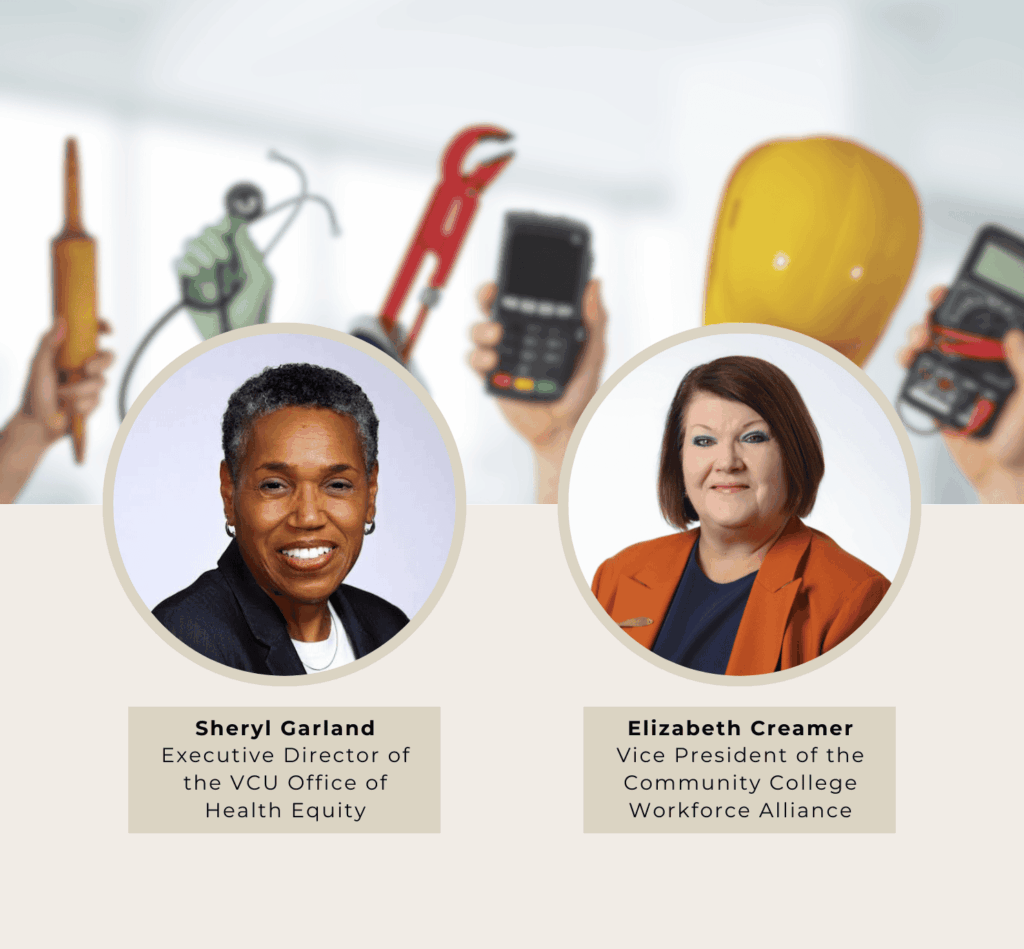
Elizabeth Creamer and Sheryl Garland were active in the coalition’s formation while also addressing workforce-related issues within their respective organizations.
Sheryl, who serves as VCU Health System’s Chief of Health Impact and Executive Director of the VCU Office of Health Equity, was focused on improving the healthcare pipeline and addressing increasing vacancy and turnover rates for entry level positions, some as high as 50 percent. Representing VCU Health on WorkforceCoalitionRVA as one of the industry partners, she also joined a subsidiary initiative called Network2Work, which focuses on connecting employers with potential employees.
Meanwhile, Elizabeth Creamer, Vice President of the Community College Workforce Alliance (CCWA), which is the workforce development division of Reynolds and Brightpoint Community Colleges, saw a disconnect between students seeking healthcare training and available jobs in the healthcare field. She too is a part of Network2Work.
It was during these meetings that Sheryl and Elizabeth began comparing notes. As Elizabeth tells it, Sheryl was the first to share the idea of developing a new program that would create direct pathways from community college certifications to jobs in the healthcare industry.
“CCWA has students, and one of their goals is to make sure those students are employed,” Sheryl said. “We had jobs, and we were looking for people with the right certifications and credentials to fill out those jobs.”
Together, Sheryl, Elizabeth and their respective organizations set out to create an intentional pathway where community college students with specific training could be funneled into high-need, market competitive jobs with benefits at VCU Health. So began the partnership through the Pathways to Healthcare Workforce program.
The first issue was determining what exactly this “pathway” would look like. At VCU Health, one critical need was for healthcare aspiring students to obtain a Certified Medical Assistant (CMA) credential; a credential provided by CCWA. This was the opportunity Sheryl and Elizabeth needed. Working together and with support from their organizations, they brought together teams to build an intentional program to better connect students with available jobs.
Now, when students register to earn their Medical Assistant certification through CCWA, they know that VCU Health is not only a program sponsor, but an engaged support system, preparing them for a job that’s waiting for them once they graduate.
“The students received special services from VCU Health, including guidance from health care professionals and worksite observations,” Elizabeth said. “As the partnership went on, it started to get more and more sophisticated.”
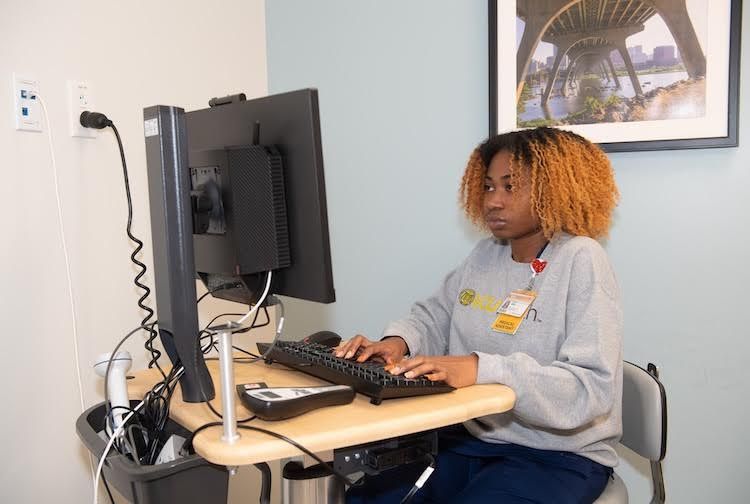
Images courtesy of The Community College Workforce Alliance (CCWA). Used with permission.
Investment in the professional growth of the students did not end once they were hired. They were encouraged to explore other opportunities within VCU Health, with the support of a career development specialist designated to work closely with new hires from CCWA.
Since program launch, VCU Health has hired over 140 CMA graduates from the Pathways to Healthcare Workforce program. Today, the turnover rate for these employees is significantly lower and there are more opportunities for these employees to grow as professionals.
Meanwhile, CCWA has seen a dramatic 97% increase in their enrollment, especially among young adults, mothers, and people of color. Many of these individuals now have medical insurance for the first time and have earned tuition assistance to further their education.
Sheryl and Elizabeth credit much of the success to the combined efforts of VCU Health’s Porsha Bennett and CCWA’s Ewa Reedy, who serve as the program managers. Described as the “heart and soul” of the program, Porsha and Ewa have taken a hands-on approach to the process that not only promotes student achievement but further emphasizes the critical importance of ongoing collaboration.
That isn’t to say there weren’t some challenges along the way.
“We learned that when you try to put something innovative on top of a well-oiled system, it can cause unexpected issues,” Sheryl remembers. “But we figured out how to work through these complicated systems in order to help people.”
Sheryl and Elizabeth have also seen firsthand what this partnership has meant for students.
“It’s been profoundly transformational for them,” Elizabeth said. “This is often their first time on a college campus, maybe the first time they feel successful in a learning environment. Our graduates are getting a certification. They’ve accomplished something. They’ve made it. And in healthcare, they find something they’re good at.”
Andrea Shearin can certainly attest to the power of the healthcare career path she’s on. “Being a mom of five and an at-home braider, I wanted something different in my life and career,” Andrea said. “I wanted to have more stability.” She recently graduated from CCWA as a Certified Medical Assistant and thanks to the program, she went on to work at VCU Health.
“It’s never too late to start,” she said. “Whatever you’re going through, you can see it through.”
Thanks to the success of the program, there are now conversations taking place about expanding this program to different areas, partnering with additional community colleges, and developing similar pathways for those earning credentials in other high-need roles like operating room technicians, certified nursing assistants, registered nurses, respiratory therapists, and more. Why is the program so effective? Elizabeth and Sheryl emphasize the importance of building on a successful approach that relies on community partnerships.
“We’ve got to have the power of these partnerships,” Elizabeth said. “We’ve got to have the community organizations engaged. They are the best source of support services for our students.”
“We know it works here,” Sheryl agreed, “and now we’re going to replicate the model in rural communities and expand the model in Central Virginia.”