

Philanthropy and Estate Planning in the Shadow of the TCJA’s Sunset
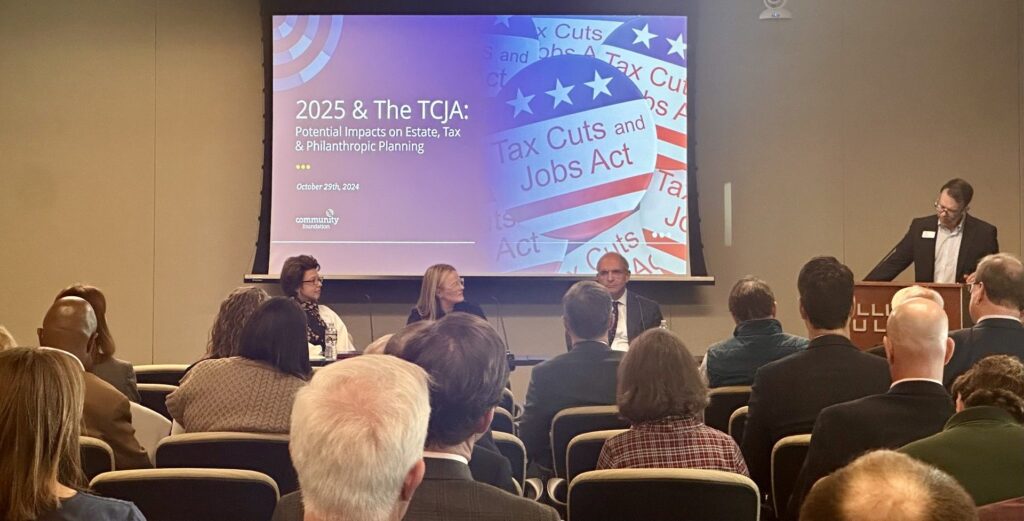
On October 29th, the Community Foundation for a greater Richmond hosted a panel discussion for Foundation fundholders and professional advisors to discuss the future of the 2017 Tax Cuts and Jobs Act (TCJA) and its impact on estate, tax, and philanthropic planning. That evening, a group gathered at the offices of Williams Mullen to learn more about possible implications should the law be altered or expire at the end of 2025.
Moderated by the Community Foundation’s Brandon Butterworth, Vice President of Philanthropic Services, the expert panel featured Farhad Aghdami, Partner at the law firm, Williams Mullen, Jen Flinchum, CPA, Partner at tax firm, Keiter, and Jeri Turley, Principal of Winged Keel Group. Together, the panelists explained how potential changes to the TCJA could impact donors and ways individuals and families could prepare from a tax, estate, and philanthropic perspective.
The panelists began by explaining how the TCJA represented a significant overhaul of the individual tax code. It lowered both individual and corporate tax rates, got close to doubling the estate tax exemption, and nearly replaced the Alternative Minimum Tax (AMT).
They discussed how these changes encouraged more donors to begin including philanthropic planning as a part of their overall estate planning strategy. There was also broad agreement that ever since the TCJA passed in 2017, many higher-income families had begun including charitable giving as a critical part of their larger estate planning because they felt their children were in a good financial position.
The main thrust of the conversation, though, focused on the end of 2025, when the TCJA is scheduled to sunset, and exemptions will decrease. As with most political and economic considerations, the panelists agreed that there is a lot of uncertainty about what actual changes are in store for the TCJA. However, here are several of their projections and practical tips:
Without any additional action by Congress, the expiration of the TCJA is estimated to reduce estate tax exemptions down to $7.5 million for individuals and $14.5 million for married couples in 2026. However, now that the election results are in, there is a greater probability that the TCJA will be extended.
Depending on the makeup of Congress going forward, the appetite for legislative changes, and the ever-evolving political and economic landscape, the panelists agreed that much was yet to be determined. Despite several possible scenarios, they arrived at similar conclusions: Be proactive.
Advisors should reach out to their clients now to explain potential changes and impacts. Likewise, individuals should contact their advisors to begin planning for a variety of outcomes and to take advantage of the current high exemption levels.
Individuals and families should consider preserving the exemption using structures like trusts and gifting appreciated assets to avoid capital gains taxes.
Qualified Charitable Distributions (QCD) from IRAs remain another tax-efficient way to make charitable gifts.
The panelists also warned that any movement by Congress to amend the TCJA could arrive with very little notice, causing a flurry of activity and scramble as 2025 draws to a close. If you would like to discuss charitable giving in the context of you or your client’s estate plans, or have any questions about charitable giving, please reach out to your Philanthropic Advisor or our Philanthropic Services team at the Community Foundation.